
Guides · 2026年11月21日
Jiufen and the northeast coast: the mountain town day trip
Jiufen is the day trip Taipei keeps recommending, a gold mining town of stepped lanes and teahouses hanging on a ridge above the East China Sea. Done badly it is a crowded hour on one shopping street. Done at the right pace it is a full coastal day: the rock formations at Yehliu, the mining landscape around Jinguashi and the Golden Waterfall, then Jiufen itself in the late afternoon as the lanterns come on. How the town got its name and its gold, how to pace the day, and how to get there and back without the stress.
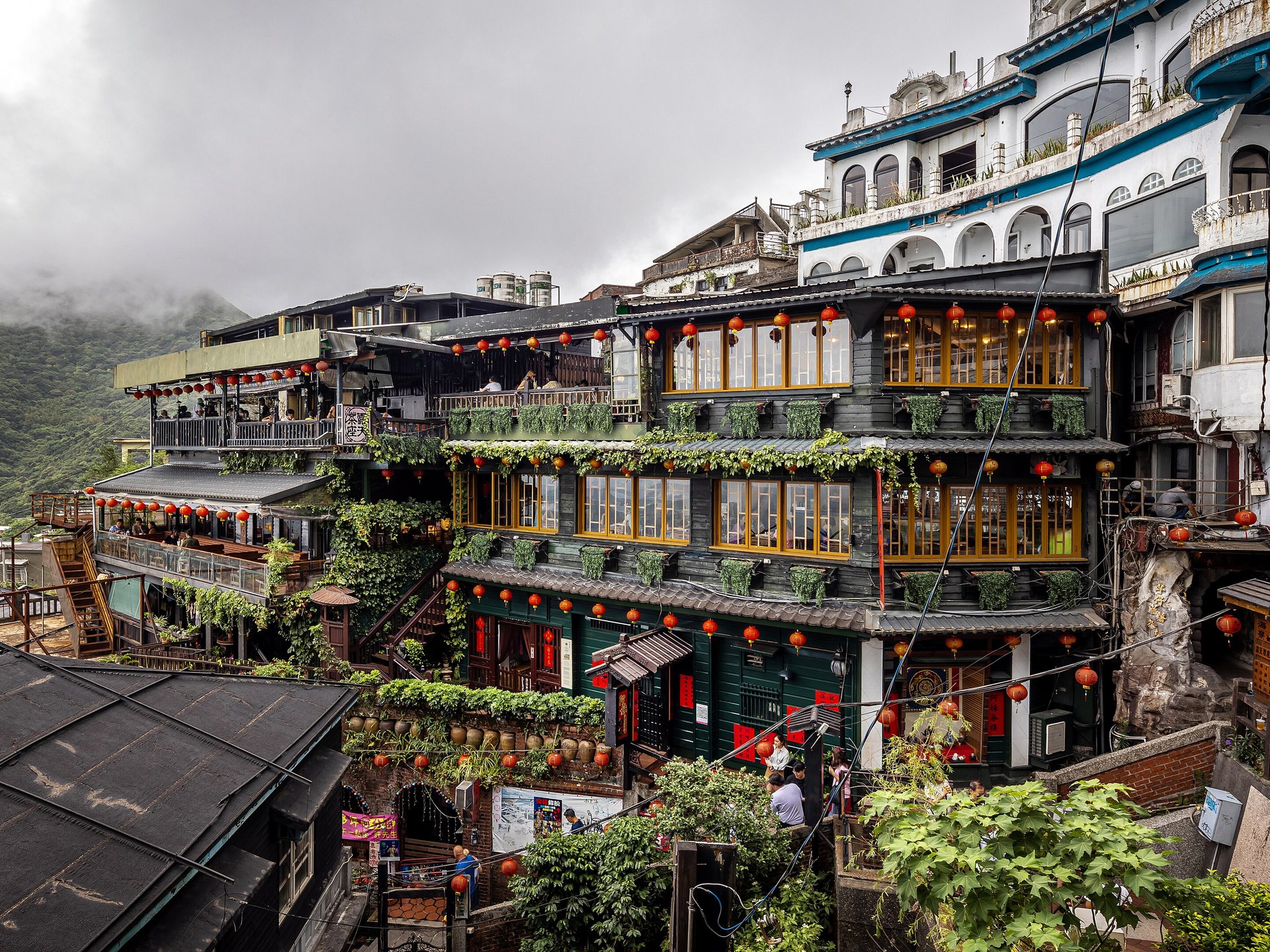
There is a moment, on the right evening, when Jiufen justifies every word written about it. The day buses have gone, the light is leaving the sea below, and the red lanterns come on along the stepped lanes one terrace at a time, until the whole hillside town is a string of warm lights above a dark coast. Getting that moment, rather than the midday crush on the snack street, is what this guide is for. Jiufen sits in Ruifang District in the hills of New Taipei, next to the mountain and facing the sea, and it pairs naturally with the northeast coast below it: the same day can hold Yehliu's rocks, a mining valley and a teahouse at dusk, if you run it in the right order. Our events calendar carries what else is on around Taipei and New Taipei during your stay.
Nine portions: how Jiufen got its name and its gold
The name comes first, because it is a good story and the official one. Before the gold boom, the Tourism Administration records, Jiufen's main business was camphor, processed in stoves grouped in sets: ninety stoves in all, ten to a processing site, making nine sites. Jiufen translates as nine portions or nine sections, and the name stuck to the settlement that grew around the work.
Gold rewrote the place. In 1890, the administration's history continues, gold was struck near Jiufen, and the poor village drew prospectors by the thousand, some 4,000 families at the height of it. Jiufen became a gold city, called in its day a little Shanghai or a little Hong Kong, a mountainside of mines, dormitories, shops and entertainment built for men spending mining money. When the gold mining declined, the town faded with it, and for decades Jiufen was a quiet, handsome ruin of itself. Cinema brought it back: films shot here won international attention, Hou Hsiao-hsien's A City of Sadness, which took first prize at the Venice Film Festival, above all, and visitors came to see the streets the camera had loved. The teahouses followed, then the snack shops, then the crowds. What you visit today is a mining town on its third life, as a place people come to look at the view its miners were too busy to notice.
The two streets that matter
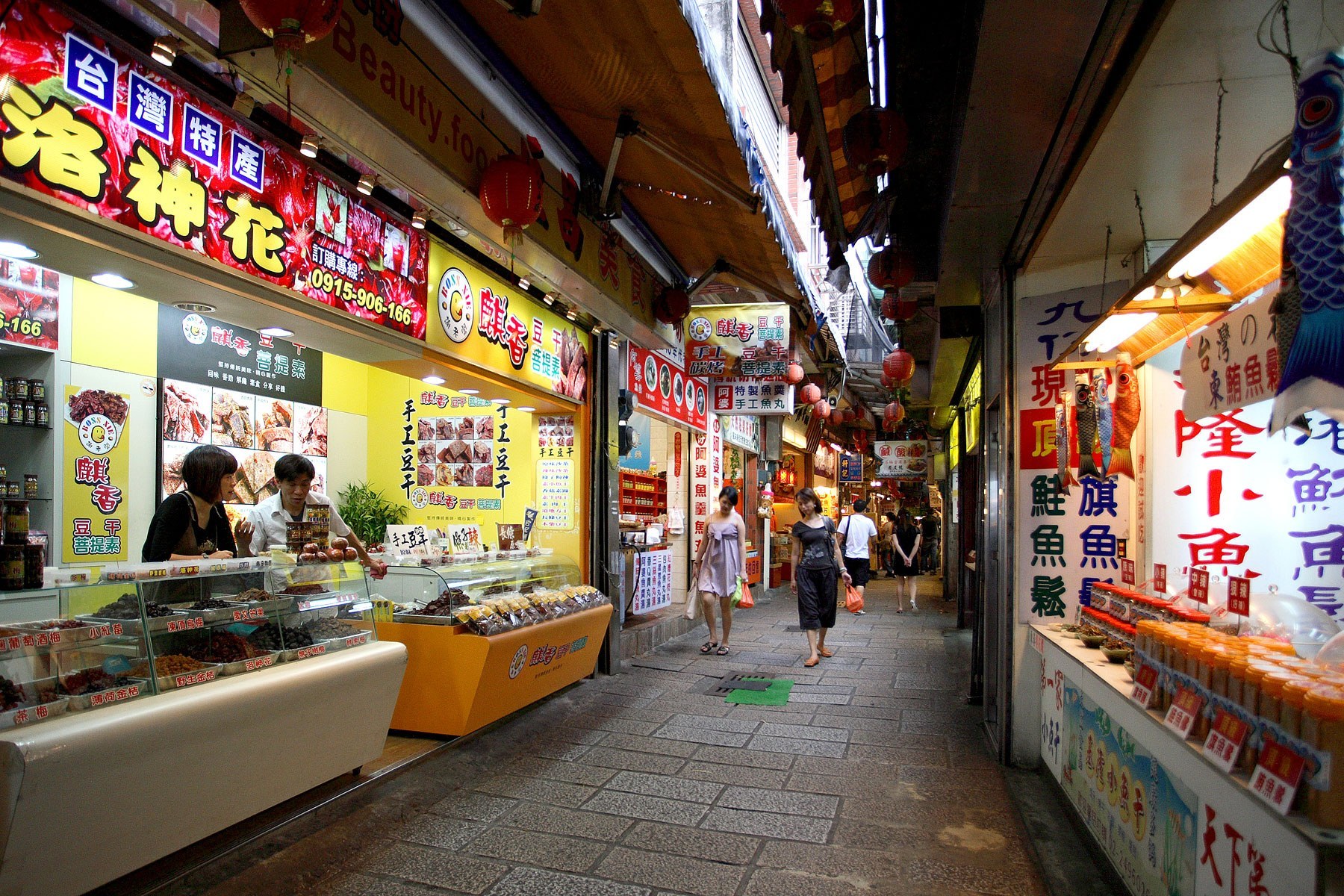
Jiufen's geography is simple once you are standing in it. Jishan Street is the old street proper, the covered, climbing lane of food stalls and souvenir shops that most visitors mean by Jiufen: taro balls in sweet soup, the town's signature dish, fish ball soup, peanut ice cream rolls, tea eggs and a hundred other small things to eat standing up. It is fun, it is dense, and on a weekend afternoon it moves at a shuffle. Shuqi Road is the other axis, a steep stone stair street dropping past the Shengping Theater and the teahouses, with the sea opening out at every turn of the steps. The famous photographs are all Shuqi Road: the lanterns, the red signs, the view framed between old buildings.
The right way to do the pair is to eat on Jishan and sit on Shuqi. Graze the old street while you have the energy for crowds, then take your pot of tea slowly, on a terrace, when the day trippers thin. The teahouses are not a side attraction here; in a town built on looking at weather over water, they are the main event with a table.
The teahouses: Amei and the old houses
Two names anchor the teahouse scene. Amei Teahouse stands on Shuqi Road in a building of strong Japanese style, and New Taipei's travel site tells its pleasing origin: it began as a blacksmith's shop, run by Amei's grandfather making tools for the local miners, and Amei converted it into a teahouse as tourism rose, making it the first of its kind in Jiufen and one of the town's representative buildings. Its tables look over the mountain and sea view the town is famous for, and its lantern lit front is the building in half the night photographs of Jiufen, helped by the persistent rumour that it resembles the bathhouse in Hayao Miyazaki's Spirited Away. The rumour is a rumour; the city listing reports it as one, and the copy here does the same. The tea and the view need no film connection to earn their keep.
Jiufen Teahouse, on Jishan Street, is the quieter counterpoint: an old house bought in 1987 and kept with most of its original structure, an inner courtyard opened for light, a fishpond and garden, and rooms of antique style furniture where the focus is tea, ceramics and painting. Where Amei is the spectacle, Jiufen Teahouse is the retreat, and on a wet day, which this coast supplies generously, its courtyard is the best seat in town. Order a pot of high mountain oolong wherever you land, ask for the local brewing method to be shown once, and then let the weather do the entertaining.
The coast below: Yehliu, the mining valley and the waterfall
A Jiufen day that starts in Jiufen wastes the coast it stands on. The northeast and north coasts below the ridge hold the rest of the day, and the classic order is rocks first, mining country second, town last.
Yehliu Geopark, in Wanli District, is a cape about 1.7 kilometres long and less than 300 metres at its widest, a headland of sandstone worked by wave erosion, wind weathering and crustal movement into the strangest natural sculpture garden in Taiwan: mushroom rocks, candle rocks, ginger rocks, sea caves, tofu rocks and potholes. Its emblem is the Queen's Head, a mushroom rock whose top concretion split in 1962 and 1963 to leave the profile of a queen with a long, slender neck, a neck that natural weathering keeps thinning, which is why the park talks about reinforcement and why you should see it sooner rather than later. The scenic area administration lists opening hours of 08:00 to 17:00, extending to 18:00 in July and August, and the Taipei Fun Pass listing gives a full price ticket of NT$120. Go early, walk the full cape to the quieter third section, and be back on the road before the tour groups reach the Queen.
Between Yehliu and Jiufen, the road passes the mining landscape that explains the town: Jinguashi, the other gold settlement, with its terraced ruins, the Golden Waterfall, where mineral rich water runs gold over the rocks, and the Yin Yang Sea, the bay where yellowed fresh water meets the blue of the East China Sea in a visible two tone swirl. None of these needs long; together they turn a snack street visit into a day that understands itself, the coast that fed the mines, the mines that built the town, the town that now feeds its visitors. The private tour in the click plan runs exactly this sequence, ending with an hour and a half on Jiufen Old Street, which tells you the shape is the standard one for a reason.
Getting there, and the timing that makes it work
You have three straightforward options. Public transport is cheap and well worn: buses run from Taipei, from Zhongxiao Fuxing and Ximen among other departure points, directly to Jiufen Old Street, and the train and bus combination runs through Ruifang Station, where local buses climb to the town. The Jioufen Teahouse's own transport page lists the pattern plainly: the 1062 bus from Taipei, the 965 from Banqiao and Ximen, or the train to Ruifang and the 788 or 827 bus up. Driving is possible and parking is limited; the same page names the town's two main car parks, which fill on weekends. A private tour removes the logistics entirely and buys you the coast stops without timetable arithmetic, at a private tour price.
Timing matters more than transport. Start early for Yehliu, reach Jiufen by mid afternoon, and stay for the lanterns: the single most common Jiufen disappointment is leaving at five, an hour before the town turns into the place in the photographs. Eat your way up Jishan Street before the dinner hour, take tea as the light goes, and ride down in the dark. Weekdays are calmer in every respect; if a weekend is what you have, the early start and the late finish matter twice as much, because you will be moving against the crowd in both directions. Rain is not a reason to cancel: this is one of Taiwan's wettest corners, the teahouses were built for watching weather, and the lanterns reflect beautifully on wet stone. Bring shoes that grip; the steps are steep and they shine when wet.
Sleep in Taipei and day trip, as most visitors do: Jiufen's lanes are beautiful and impractical with luggage, and the capital's beds, stations and night markets wait at the bottom of the hill. The stay button below is the capital base this guide assumes. Done this way, Jiufen stops being the crowded hour people warn you about and becomes what the films saw in it: a lantern lit mining town above a dark sea, with a pot of tea going cold because the view kept interrupting. For more days out from the capital, our This Weekend page keeps the current listings.
Book the Jiufen, Shifen and Pingxi private tourvia Viator · affiliate link
Book Yehliu Geopark ticketsvia Klook · affiliate link
值得注目的活動,直接送到你的信箱。
每週三,把週末及之後值得注目的活動,直接送到你的信箱。