
Guides · 2026年11月28日
Around Taiwan by train: the island circuit in stages
Taiwan is one of the few islands in the world you can circle entirely by train: a loop of close to 900 kilometres that was only completed in 1991, when the South Link line closed the gap across the southern mountains. A stage by stage guide to riding the circuit as a journey rather than a stunt: the fast west coast, the cliff coast to Hualien, the Rift Valley, the South Link's tunnels and sea views, and the branch lines worth breaking for.
Most islands make you choose a coast. Taiwan lets you ride all of them in one loop. The Taiwan Railway network circles the island in a circuit of close to 900 kilometres and more than 240 stations, from the crowds of Taipei Main Station to near-empty platforms in the southern mountains, and the remarkable thing is how recently the circle closed: the South Link line across the island's southern tip only opened in December 1991, the last section of the loop to be built and, in 2020, the last to be electrified. Riding the whole circuit in stages, with nights in the towns the expresses pass through, is the single best way to understand Taiwan's geography: four coasts, two mountain ranges and one long valley, read from a train window. Our events calendar carries what is on in the towns along the way.
Stage one: the west coast, at speed
Start in Taipei and go clockwise, down the west coast, where Taiwan keeps its cities. This is the railway's home ground: the Western Trunk line through Taoyuan, Hsinchu, Taichung, Changhua, Tainan and Kaohsiung, dense with commuter trains and expresses, running through the flat, built-up plain between the mountains and the strait. The high speed rail shadows the same corridor further west and does it in as little as an hour and a half end to end, which raises the circuit's first decision. Purists ride the conventional line throughout, stopping where the old railway towns invite it: Changhua for its fan-shaped roundhouse, Tainan because Tainan always deserves a night. Pragmatists take the high speed train for the long western haul and save their slow hours for the coasts that repay them. The pass below exists for exactly that western work, and the operator's own comparison has a single Taipei to Zuoying return nearly covering its price.
Get the THSR rail passvia Klook · affiliate link
Stage two: Kaohsiung to Taitung, the South Link
At Kaohsiung the circuit turns east and becomes a different railway. The line runs through Pingtung and Fangliao, the junction for the south, then commits to the South Link: 98 kilometres of single track railway across the southern end of the Central Mountain Range, through tunnel after tunnel, emerging for sudden views of the Pacific as it rounds the island's foot to Taitung. It is the youngest main line in Taiwan and feels like the oldest, a mountain railway built a century after the others, and its completion in 1991 is what turned two coastal railways into a circuit. Sit on the left heading east for the sea views as the line nears the coast past Fangshan, the southernmost station in Taiwan. The vintage minded should know about the Breezy Blue service, the restored non air conditioned diesel hauled train with openable windows that runs between Fangliao and Taitung as a deliberate piece of nostalgia. However you ride it, this stage is the circuit's soul: three hours in which Taiwan stops being a corridor and becomes an island. It was also the last piece of the national network to modernise: the South Link's final section was electrified only in December 2020, with the first electric passenger services running on 20 December of that year, which closed the book on the diesel era around the whole circuit. The line still feels younger than the rest of the railway, because it is: engineered a century after the west coast line, through harder country, for a country that had finally decided its two coasts were one island.
Stage three: the Rift Valley to Hualien
From Taitung the line turns north up the East Rift Valley, the long green trough between the Central Mountain Range and the Coastal Range, through rice country and small farming towns: Guanshan, Chishang, Yuli, Ruisui, Fenglin. This is slow Taiwan at its most likeable, a valley of paddies, betel nut and hot springs, where the expresses stop often enough to make town hopping easy and the local trains stop everywhere. Break the stage at Chishang for the rice fields that made its lunchboxes famous, or at Ruisui for a night in the springs. The valley line is also the circuit's practical gift: it is beautiful without demanding anything, an afternoon of window scenery that costs a local fare. Ride it when the rice is turning if you can choose your season, in the weeks before the valley's harvests, when the paddies run green gold to the foot of both ranges and the small stations smell of warm grain: the Rift Valley in harvest light is the closest Taiwan's railway comes to a pastoral painting, and it costs the price of a local ticket.
Stage four: Hualien to Taipei, the cliff coast
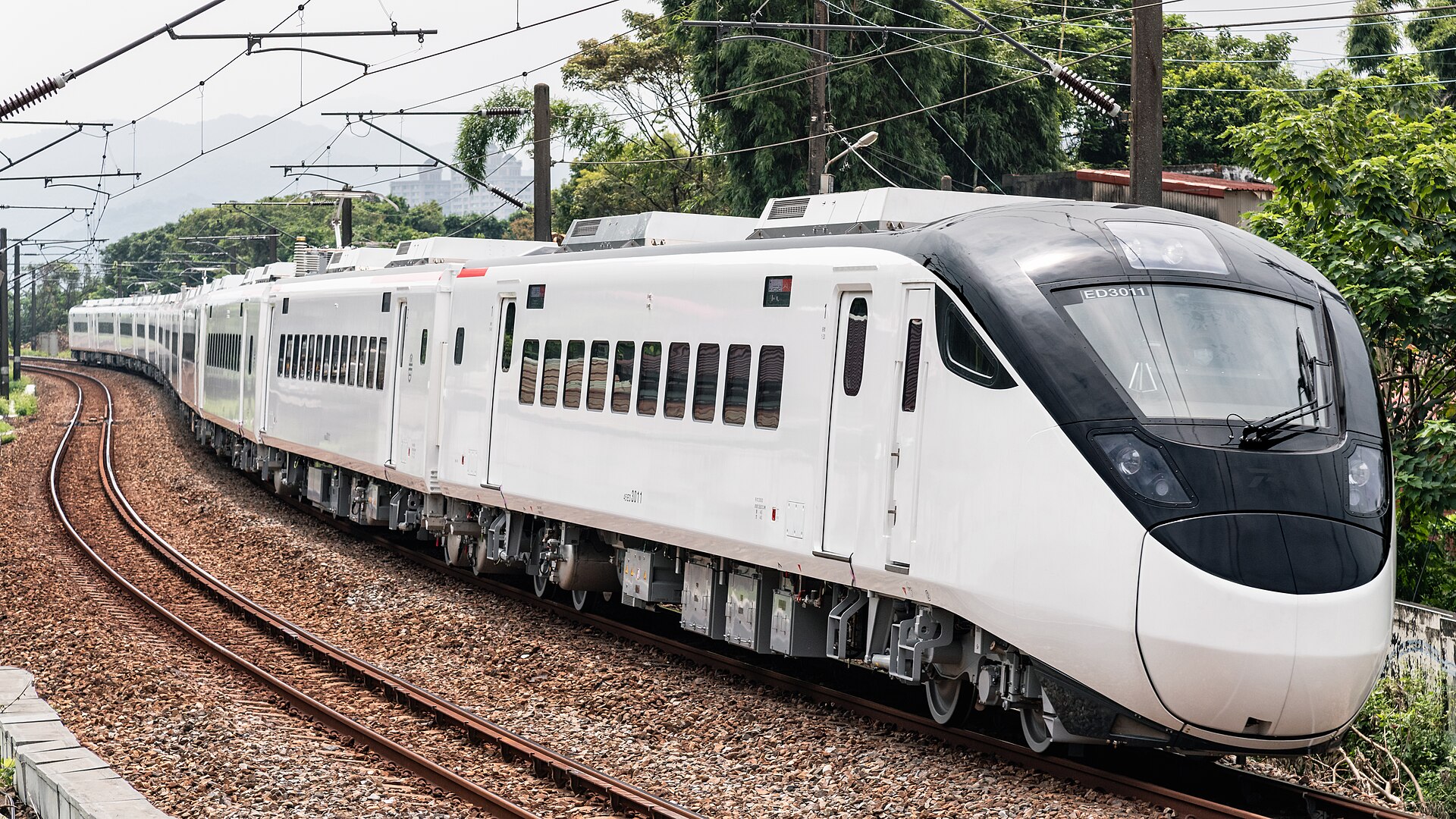
The last stage is the famous one. North of Hualien the railway shares the coast with the Suhua Highway, running through tunnels and along cliff edges above the Pacific, past the Qingshui Cliffs where the mountains fall straight into the sea, then through the tunnelled Yilan line with its glimpse of Turtle Island offshore, and down through the old mining country around Ruifang into Taipei. The tilting Puyuma and Taroko expresses were built for these curves and do the run in about two hours; the newer EMU3000 sets run the same road in a little longer with more room. East coast express tickets are the circuit's scarcest resource and sell out around holidays, so book this stage first when you fix your dates, through the railway's own booking system, and let the other stages arrange themselves around it. Our live east coast by train guide covers the Hualien and Taroko stretch in its own detail; this stage is its continuation home.
The branches worth breaking for
A circuit ridden without detours misses the railway's best small rooms. The Pingxi branch, up the Keelung River valley from Ruifang, is an hour of waterfalls, old mining towns and sky lanterns. The Neiwan branch from Hsinchu climbs into Hakka hill country. The Jiji line in Nantou runs through the earthquake scarred foothills to Checheng's timber pond. And at Chiayi the narrow gauge Alishan Forest Railway, a separate system entirely, climbs from the plain into the high cypress forest, fully reopened in 2024 and deserving its own days rather than a detour. None of these is on the circuit; all of them are reasons the circuit is worth riding slowly.
Riding the circuit: the practical shape
Know your trains before you go. The circuit's expresses come in families: the tilting Puyuma and Taroko sets, built to lean into the east coast curves; the EMU3000 Tze-Chiang sets, the railway's newest intercity trains, in service since the end of December 2021, twelve cars with a Teng-yun business cabin at one end; and the ordinary Tze-Chiang and local trains that do the valley and branch work. The distinction that matters is reservation: the named expresses are reserved trains where a ticket is a seat, while the local trains of the valley and the west coast take passengers as they come, which is what makes town hopping between expresses so easy. Ride the expresses for the long coastal stages, ride the locals for everything in between, and the circuit assembles itself. Give the loop four days at a sprint and a week at a slower pace, with nights in Tainan or Kaohsiung, Taitung, one Rift Valley town and Hualien. Ride clockwise and the sea sits on your left for both great coastal stages. Reserve the east coast expresses ahead; take the west coast as it comes. Keep one unplanned half day in hand, because the circuit's pleasures are mostly unplanned: a station town that charms you, a valley town in harvest light, a southern platform with nobody on it but you and the Pacific wind. Taiwan built this loop late and almost by accident, a byproduct of linking its coasts. Ridden whole, it reads like the island's autobiography, one stage at a time. For what is on when you pass through, our This Weekend page keeps the current listings.
值得注目的活動,直接送到你的信箱。
每週三,把週末及之後值得注目的活動,直接送到你的信箱。