
Guides · Tue 24 Nov 2026
Taichung in two days: the city in the middle
Taichung, the central city most visitors pass through on the way to somewhere else, deserves its two days: a theater that is an architectural event, a greenway of museums and old markets, a village painted in rainbows, and a wetland sunset that ends the second day perfectly.
Taichung suffers from its geography. It sits in the middle of Taiwan's western plain, on the high speed line between Taipei and the south and on the road to Sun Moon Lake and the central mountains, and a generation of travellers has treated it as a connection rather than a destination. That is a mistake the city itself does not make. Taichung is Taiwan's second city in spirit if you ask its residents, a place of universities, design shops, bubble tea claims, big architecture and easy evenings, with a coast of wetlands and wind turbines twenty minutes from its western edge. Two days gives you the city's own pleasures rather than its day trips: day one in the center, on foot and by appetite; day two out to the painted village and the sea, ending in a sunset on the mudflats. Our events calendar carries Taichung's exhibitions and festivals during your stay.
Day one, morning: the theater and the greenway
Start with the building Taichung is proudest of. The National Taichung Theater, designed by the Japanese architect Toyo Ito, is described by the city's own tourism bureau as one of the world's most difficult construction projects: a beamless structure of curved walls, a building that flows rather than stands, with no straight interior quite like a normal theater's. The bureau's visiting advice is the right one even if you have no performance ticket: come for the architecture, stay for the floral and design shops inside, walk its roof garden, and treat the building as the city's living room, which on weekends it plainly is. Its listed hours run from late morning into the evening, later on Fridays and Saturdays; check the theater's own listing for your day, and if a performance fits your evening, the building at work is better than the building at rest.
From the theater, the city's green spine runs east: the Calligraphy Greenway, a long landscaped corridor of lawns, trees and public art linking the theater district to the science museum quarter. Along and around it stand the National Taiwan Museum of Fine Arts, the National Museum of Natural Science with its botanical garden, and a density of cafes, bakeries and design stores that makes the greenway the city's weekend promenade. The science museum is the families' anchor and the fine arts museum the quiet one; both reward a morning. This is Taichung at its most characteristic: green, unhurried, well fed, and quietly pleased with itself.
Day one, afternoon: old Taichung, Miyahara and the markets
The center's other face is older and sweeter. Around the old station, the Japanese era streets hold the shops that made Taichung's food name: sun cakes, the flaky pastry the city claims as its own, pineapple cakes, and the tea and dessert houses of the old commercial district. The most famous interior is Miyahara, a former ophthalmology clinic from the Japanese era rebuilt as a palace of ice cream, chocolate and pastry, all dark wood, high shelves and queues: part shop, part theater, and the city's essential souvenir stop whether or not you need an eye test. The nearby markets and the station railway cultural park fill the rest of the afternoon, and the Fourth Market and the old shopping streets give the center a lived-in grain that the theater district, for all its polish, does not try to copy.
The old center also keeps the city's memory in smaller rooms: the Taichung Literature Museum in its Japanese era police dormitory buildings, the former mayoral residence, and the broadcasting bureau's old studios, all within the same walking weave, all the kind of modest, well kept heritage that rewards an unplanned hour.
Eat the evening away at Fengchia Night Market, up by Feng Chia University in the west of the city, routinely counted among Taiwan's largest and most inventive night markets, the place where new snack ideas are tested on student crowds before the island copies them. Our city by city night market guide covers Fengchia in its Taichung section; here it is enough to say go hungry, go in a group if you can so the ordering multiplies, and treat the market as dinner, dessert and entertainment in one walk. Taichung's other claim on your appetite can wait for a cafe table tomorrow: this is the city that argues, with some justice, that bubble tea was invented here, and the big tea houses of the center will happily make the case over a pot and a glass.
Day two: Rainbow Village and the road to the sea
Day two leaves the center. Rainbow Village, in Nantun District, is a lane of military dependents' housing saved by paint: the city's tourism bureau tells the story plainly. Huang Yong-fu, an elderly resident, began painting from boredom, covering the walls of the threatened village with portraits, animals and blocks of childlike colour, and visitors came in such numbers that the painted lanes were preserved. It is small, it is joyful, and it takes less than an hour unless the colour slows you down, which it tends to. Go in the morning for the light and the thinner crowds, and combine it with the old street and temples of Nantun nearby rather than treating it as a lone pilgrimage.
Then west, to the coast and the day's real destination. The Gaomei Wetlands, on the south side of the Dajia River estuary in Qingshui District, are Taichung's wild edge: a protected flat of mud and sand where, the city's nature guide records, over 120 species of bird have been recorded, with the best birdwatching running from June to February, fiddler crabs working the mud, a boardwalk carrying visitors out over the flats, and a skyline of wind turbines and the Gaomei Lighthouse turning the whole scene into a piece of land art. The visitor center, a spiral roofed building of some 8.4 hectares of grounds on the city's description, runs an ecological experience hall and an observation deck built for exactly what everyone comes for.
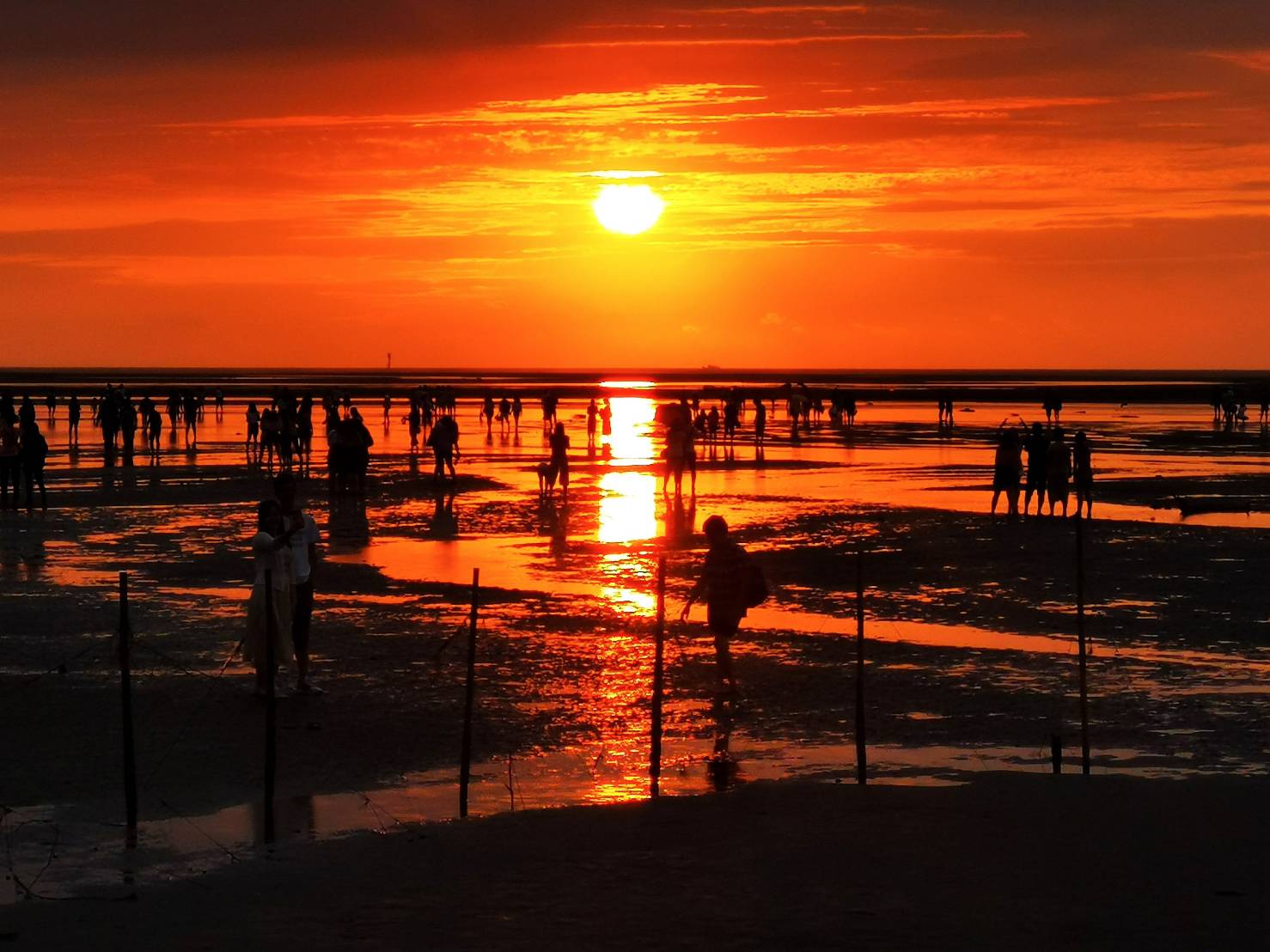
What everyone comes for is the sunset. The wetlands face west over the Taiwan Strait with nothing in the way, and on a clear evening the sun drops into the sea while the wet flats mirror it, the turbines black against the colour, the birds coming in over the water. It is routinely praised in the city's own material as a once in a lifetime sunset, and for once the civic boasting undersells it slightly. Time your arrival for the last two hours of light, walk the boardwalk out, and let the day end there. The day tour in the click plan runs Rainbow Village, the theater, Miyahara and the wetlands at sunset in one commercial loop for travellers short of a car; independent travellers can do the same geography by bus and taxi with a little more arithmetic.
Book the Gaomei Wetlands and Rainbow Village day tourvia Klook · affiliate link
Where to base, and the Taichung rules
Base in the center, near the station or along the greenway, according to taste: the station quarter for the old shops, the markets and the onward trains; the theater quarter for the green, the museums and the newer hotels. Taichung is a bus and taxi city more than a metro city for a two day visitor, and its pleasures are spread in a loose west to east line that the greenway stitches together. Two rules finish the plan. Protect the Gaomei sunset from the weather: if your two days offer one clear evening, spend it on the flats, and swap the days around it. And do not use Taichung only as the Sun Moon Lake platform it also is: the lake will still be there on day three, and the city you slept in deserves to have been seen. The stay button below is the city's wired search, and our This Weekend page keeps what is on while you are here.
Stay in Taichungvia Booking.com · affiliate link
More reading on the articles page, or go straight to the events calendar.
Noteworthy events direct to your inbox.
Get what's noteworthy for the weekend and beyond every Wednesday in your inbox.